The year Emma Jones poisoned someone she was 10 years old. She hadn't planned it. In fact, she had never planned anything in her life. She was told what to eat and wear, when to go to bed, and to be thankful to the boys who pushed her in the playground for the attention they spared her.
“Don't make a fuss, it probably means they like you,” her mother told her as she wiped the fat tears from her chubby cheeks with her free hand, the other holding a lit cigarette.
Emma hesitated but finally told Elizabeth Jones for just how many seconds she had stopped breathing, winded by a punch to the stomach delivered by a boy from her class outside the school gate. “I will speak to the headteacher when I can,” Elizabeth exhaled, her words carried by the cigarette smoke, spiralling upwards into nothingness.
Emma was a quiet girl with loud thoughts that sometimes threatened to derail her. Shame, however, was an enforcer of approved behaviour and she was swimming in it. When she was seven, she had lined up alongside other girls under a Magnolia tree that arched over the railings of her schoolyard, waiting to be kissed. The game had rules, and she followed them obediently, hoping that a boy named Brian would pick her. Brian didn't kiss her then but when she was nine, he put his hand up her skirt. She didn't tell her mother about him or the boys who followed the years after and never asked for permission.
Despite being plain-looking, Emma was, from an early age, intensely aware of how looks had the power to change what the future held for girls. She often stayed in her room listening to the London rain, watching it scar the windows as she flicked through her mother's fashion magazines, studying the poses of models, the way their slim bodies lay sprawled over sofas, mouths slightly opened as if gasping for air, and eyes with the almost sleepy quality of freshly wounded animals. She marvelled at their shiny hair, hers being the colour of ash wood, fine and lacklustre. Her mother made her wear it pinned at the sides with barrettes which eventually slipped down like melting butter. No matter what, her locks always fell flatly over the shoulders she hunched to hide her early protruding breasts. She constantly rearranged her skirt as it rode up, pulled upwards by her expanding hips. Although she begged her mother to size up her clothes, Elizabeth told her to instead put the biscuits down until they fit.
At ballet class, the message was the same. “If you slim down you may have a chance,” her teacher told her one afternoon after the students had performed for two examiners and Emma got a hopeful but cautious nod from the former ballerinas. Competent, and creative, but lacking lightness, the report said. “A boiled egg and a lot of water will plug the stomach.” The teacher spoke calmly, her thin fingers wrapped around her hair bun as she bent forward, towering over Emma who was busy removing her slippers and massaging her bruised toes. “Emma, you're good but right now everything shows, darling. A ballerina wears nothing of herself. She is grace, light, and performance, even if her feet are bleeding. She puts on a show, and she carries no baggage into it, no weight, no personal distractions.”
She spoke softly but still within earshot of the other girls who congregated in the corner in a mass of pink tutus, dishing out sarcasm under their breath. One trumpeted like an elephant while the others doubled over with laughter. Emma felt the sweat on the back of her head go cold, sending shivers down her spine. The leader of the pink pack was a girl with limpid blue eyes and elongated limbs who already at 10 delivered an arabesque with precision, her arm stretched out with an elegantly pointed finger, eyes fixed on the teacher as if to say “I, on the other hand, can be whoever you want me to be.”
That day Emma asked her mother to quit ballet.
“Absolutely out of the question!” Elizabeth's jaw tightened as more words fought to get out. “You never finish what you start. You're truly your father's daughter.” She ran her hands through her wavy blonde hair harshly, willing the sheer force of her movement into erasing them both from her mind, as she briskly walked upstairs to the bedroom.
Emma picked at the loose skin around her bitten nails until her fingers bled. The thought of going back to ballet class filled her with dread, but what made her feel afraid in her tummy, as she used to say when she was little, was knowing she was mostly alone, that there was no haven under her mother's bed covers, no neck nooks to wedge herself into for solace against growing pains, no shelter from the many storms she knew lay ahead.
Elizabeth, who collected admirers, expensive face creams, and an enviable assortment of drugs in her medicine cabinet, existed in a state of permanent irritation and nostalgia, lifted by occasional euphoria. Her laughter was as infectious as the sound of her muffled sobs emerging periodically from behind the closed doors of her bedroom in their 3-bed north London house. She had the misfortune, she often confided in her best friend, of having married a man who threw himself into investigative reporting like his life depended on it but had always failed to get her story straight. Unlike her daughter, she ate sparingly but was never without a cigarette and a cup of strong, black coffee. One woke her up in the morning while the other took away her appetite and kept her in shape. Just in case. Upstairs in her bedroom right now she sat in front of the mirror, taking in her attractive features, wondering how long until the faint luminosity her skin still held onto succumbed to the constant assault of passing time and regret.
Nicholas Jones had met his wife at university where both were reading English Language and Literature. At 20, Elizabeth Walters had already been published by a small literary magazine with the commissioning editor describing her prose as “acerbic and captivating”. Her zest for life was magnetic, and her presence all encompassing, but something about her was also liquid; hard to hold onto, easy to let go of. At first, he had watched from afar as men congregated around her like hunters cautiously circling prey, aspiring writers fuelled by pints, postulating into the night over Dickens and moral reform but mostly anticipating the feel of her breasts. She flashed bright like a breakdown hazard beacon placed on the road after a traffic accident, and they all obediently stopped before moving on to their destinations.
Nicholas didn't mind being friend-zoned by Elizabeth, as long as he could be near her when the show wasn't on. A strong coffee, no sugar. He knew how she took it, placed it in front of her, and asked no questions, watching her dim down, dented and crumpled by the night's doings. He stirred his tea and hesitated briefly, but words propelled out of his mouth before he could catch himself. “He doesn't deserve you.” She steadied herself, irritation fuelling her more than caffeine.
“What does that even mean, Nick?”
“It means, and I'm going to be blunt here, that he's auditioning his lays.” His back was turned to her. “I'm also sorry to say you're not reeking of exclusivity.” She sank into the sofa, her frame swallowed by the worn-out cushions and rusty springs.
“I know about Marianne Taylor,” she shot back defensively. “He's just figuring stuff out.”
“Is that what you call it?” Nicholas bristled. He tried to tread carefully to not spook her, but his confidence was growing as he witnessed her tumultuous relationship with Jonathan Barr drilling tiny holes into her spirit. “He has you on tap. And I couldn't give two shits about Marianne, but I care about you.”
Elizabeth didn't know what it was about Nicholas that made her feel simultaneously like dirt and gold. Perhaps it was that she was both, like some form of rough mineral that would remain lost and undervalued, washed away by streams and rivers if not polished to glowing glory by expert hands. Jonathan, conversely, had perfected a sort of magic trick, keeping her suspended in hope without ever giving her any. There was something about the shifting shape of his smile and the way he tucked her hair behind her ear after sex as he whispered "superlative" that made her feel like a goddess. It was just that sometimes she was the full affair, draped in silky white gowns, hanging grapes and all, and other times a truncated statue in a museum, on a pedestal but missing arms, and legs.
They continued to debate Barr's virtues and shortcomings as the leaves fell outside, the days grew shorter, then longer again. They talked less about him in their final year, and she mostly took her morning coffee next to him in his bed, overlooking the campus courtyard. Towards the end of the last semester, she couldn't stand the smell of coffee or anything else for that matter. Her insides forced their way out in puddles of acrid vomit each morning and she felt like she was being eaten alive. "We'll make it work," Nicholas said as she sobbed, her agency shelved until further notice by what was growing inside her. They married shortly after.
Emma was born on the hottest day of the year in June 1974. She and Elizabeth cried almost as much as each other, one for milk and comfort, the other for the shape of the rest of her days. Once Nicholas came home from his first job at a local newspaper to find six-month-old Emma naked in an empty bath crying her lungs out, her skin tinged blue, while Elizabeth slept on the rug holding the plug. Another time she sat placidly as jets of soured milk shot out of the baby's mouth, only swooping in to hold her when she sensed his footsteps approaching.
The pills the doctor gave her for what he called a moderate case of baby blues helped at first, blurring the disconnect and channelling her mothering into a functional affair. The child was clean, fed, pushed around leafy parks, and taken to playgrounds and sandpits. But after a while, it became harder to blame their porous bond on a chemical imbalance. Sometimes she would lay out all of Emma's clothes for the week on the guest bed in the nursery, line up milk bottles and formula on the kitchen counter, leave notes and instructions, and then lock herself in the bedroom for days, refusing to come out. After four or five days, Nicholas would put an end to it.
Following these episodes, their tectonic plates slowly aligned until Nicholas' edged above hers just enough to ensure peace for a while. She moved apologetically, delicate and gentle-mannered, rounded, no edges. Her worth poured out of her shame and increased with penance. The more she atoned, the kinder yet firmer his movements were, like a parent guiding a toddler, all benevolence and wisdom, rewarding her as her wandering spirit lost most of its fleeting, rebellious nature, and gathered a physical form he could finally grab hold of and keep in check. Then the cycle would start all over again.
Nicholas, meanwhile, had spent most of his time trying to shield his daughter from these periodic jolts, wedging himself into the parental nooks and crannies that Elizabeth couldn’t or didn’t want to fill. His favourite time of day was the evening, when Emma would join him in the kitchen to watch him prepare dinner. He pretended not to see when she stuck her pudgy finger in a puddle of sauce or grabbed morsels of sausage still burning hot from the frying pan.
“I think you're made of Teflon, Emmy,” Nicholas joked.
“What's Teflon, daddy?” she asked.
“This stuff on the pans, nothing sticks to it, and nothing burns,” he turned another sausage on the grill and playfully ruffled her hair. Emma licked her pink fingers.
“Oh, it burns, daddy, but I just try not to think about it.” She shoved a few more pieces into her mouth, eating them quickly before she could hear her mother's voice in her head “have you looked at yourself lately?” Then she ran to the living room. It was Thursday and she didn't want to miss George Michael on Top of The Pops. She was sure she would marry him one day and he wouldn't care one bit about how many sausages she ate. He would see inside her thoughts and take her on great adventures on his Miami yacht, doing away with both the blonde and the brunette from Careless Whisper once he found true love with her.
#
They were at it again. Emma overheard her mother's spiky tone and her father's muffled response from the kitchen as she fetched drinks for guests at the barbecue they were hosting.
“Just ask them both for stuff,” Claire said. She was Emma's best friend whose parents had divorced a year before but still engaged amicably enough to attend parties together. They were in Emma's bedroom that day, carefully beading the hair of a Girls World doll head, applying green, blue, and yellow eye shadow to make her look like the woman on the cover of Wham's “Wake Me Up Before You Go-Go” record. The grown-ups partied in the garden, their shrill voices occasionally rising above the music on the small transistor radio next to Emma's bed.
“Seriously, they are not paying attention, and you'll get loads of toys,” Claire pulled out a string of bubble gum and twisted it around her finger. Her eyes darted a coveting glance at a pile of dolls — two Strawberry Shortcake, a special edition Sindy wearing a pencil skirt and blazer, and a whole shelf of smelly letter paper with matching pencils and erasers. Emma sorted through the makeup box.
“I just wish she wasn't like this,” she said quietly. Claire shot her an inquisitive look, but Emma just pushed another bead into the doll's hair, doing it with such force it rammed the head onto the floor.
It was a hot afternoon at the end of July 1984, humid, and still. Emma loved how the summer sunshine lifted London from under its constant cloak of grey but hated how it never lasted, like it was never meant to be there in the first place and would eventually be drowned out by the force of a storm, leaving behind a trail of destruction and unfulfilled promise. She could swear she was the only person in the world wishing for long-lasting heatwaves — the kind that transported her and her surroundings to a post-apocalyptic world of some sort where nothing was as it was supposed to be, and no one could hide their true feelings anymore.
When the weather was like this, everything sounded sharper. The girls could hear the ear-splitting screams from the kids outside playing football on the street, and the chords of a song falling down the scale from the open window of a passing car. In the garden at the back of the house, the barbecue was in full swing. The women produced artificial, shrieking laughter that mixed with the clinking of glasses and the music blaring out from the living room through the open French doors. All the adults behaved on edge, laughing too loudly and drinking too much as if trying to anxiously dump the rarity of a summer's day into their cocktails and guzzle it before it vanished. It made Emma feel unsafe but also curious.
She could hear her mother now, the pitch of her voice sharp, clear, loose, all the lights on as if she had been plugged to the mains, exuding confidence and charm.
“He's the kind of man who likes to say it takes two to tango, when he knows perfectly well it takes at least three if you’re going to make it interesting,” Elizabeth mocked Nicholas drunkenly, locking eyes with one of the male guests. Collective laughter exploded in unison. Her husband took it like he always did, piercing her with a look that was both sad and furious but offering a polite smile to everyone else as he slowly edged his way to the kitchen to fetch plates of devilled eggs.
Later that night Emma woke up to find her mother in the kitchen, standing in front of an open fridge, her feet bare, hair wet from the rain that had put an early end to the barbecue, frame wobbly from too much drink. She had a piece of bread in her hand and was running it over the soft butter on the butter dish, doing away with knives, quickly shoving it in her mouth like a thieve sensing the police approaching, followed by rolled slices of ham, and skewers of cubed tinned pineapple and cheese leftover from the party.
She ate greedily, using the back of her hand to wipe her mouth, letting fruit juice run down her chin and crumbs assemble at her feet. Emma thought they looked like the trail Hansel and Gretel had left in the forest to find their way back home. She had never seen her mother like this and felt her eyes well up with immense sadness but couldn't place her emotion. Something about Elizabeth's secretive ways repulsed and embarrassed her, supressing the urge to wrap herself around her mother. Contempt was a feeling she didn't yet have words for although it wasn't an alien concept. She had felt it every time the girl with the blue eyes and her group in ballet class shrunk her to size. She turned around before Elizabeth could hear her, her feet quietly finding the steps on the dark staircase as she willed the next morning, when they would leave on holiday to where the sun belonged, firmly anchored to a predictable blue sky.
The rain had pockmarked the ground, and the birds were frenziedly feeding off the easy buffet of unearthed worms just beneath the soft grass. Nicholas moved slowly around the garden in the early morning light, clearing out the remnants of the party, bottles of half-drunk beer, and small cocktail napkins draped on bushes like torn wedding veils. Elizabeth came down the stairs into the kitchen, sat down, and drank the coffee he had already placed where she normally sat, silently, ritualistically. The drunken doings and sayings of the night before were the last step in a familiar routine. It was starting afresh now, and she wore her meekness well to collect the hard-to-win tokens of his affection, safekeeping them for use when she felt herself boil over, threatening to drown everything and everyone in her wake.
For the past two years, the Joneses travelled to the south of Portugal, where they rented a modest whitewashed house near the sea, in a secluded area up a mountain where no other tourists could be seen or heard. “It's a real find,” Nicholas boasted proudly to his wife the year before. They had made it their holiday home since, but she still wasn't convinced. They could go for days without seeing another living soul if you didn't account for the trips to the beach at the bottom of the hill.
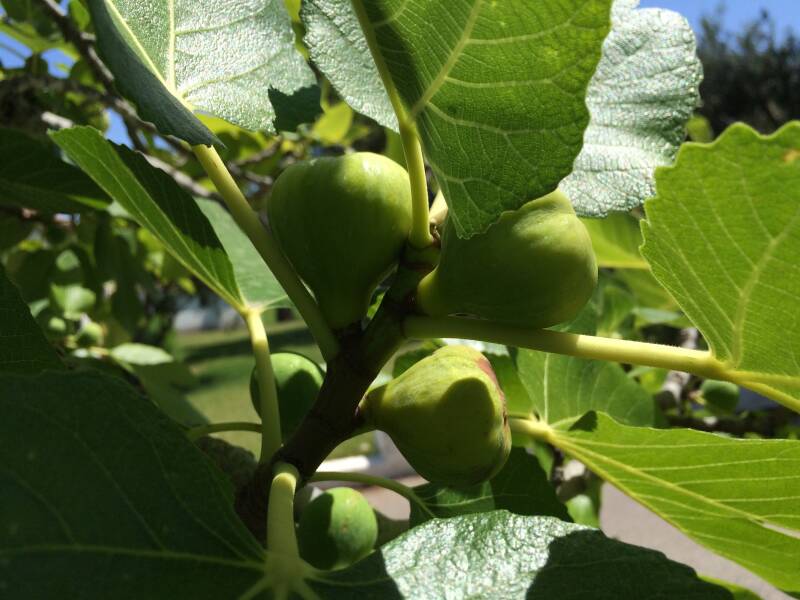
The blindingly white house had a blue stripe running across the bottom of the structure, a cool terracotta floor, and a large courtyard dotted with flower beds, where a sprinkling of slightly dried-out native plants fought for survival alongside a few deep red habanero chili peppers. They had been sown by the landlady, a curved woman in her 70's who didn't speak a word of English and spent August in an annex to the main house with her son when the Joneses stayed there. Up a flight of external stairs on the side of the building, there was a terrace where Elizabeth often retreated to for a sundowner, listening to the cicadas as the sun edged down the horizon, staining the sky in coral hues. In front of the house, a sea of green stretched as far as the eye could see — an orchard filled with fig trees. In August they would be heavy with plump fruit, hanging all the way from the top to the lower branches. The large leaves smelled earthy, with a bitter sharpness and slight aroma of coconut. The sun shone every day with an intensity Emma was unaccustomed to, warming surfaces until they burned. There was nothing gentle about it and she loved that. It spoke to her growing disquiet.
In the late afternoon, when the three of them returned from the beach, the scents hanging in the air from the fig trees would be stronger and sweeter, the fruit having spent hours macerating under the hot rays. Emma knew they would have been primed to perfection, their skin warm to the touch and seeded insides honeyed, carnal in their rusty red hues waiting to be picked and devoured. She waited until her parents went their separate ways, her mother to the terrace with her gin and tonic, and her father to a faded yellow stool, easel and a box of watercolours, before she slipped out of view and into the orchard.
Her sandy feet deftly climbed the tree until she found a nook to rest herself on. She liked to break a leaf between her fingers and take in the grassy aroma before she wrapped her hands around the figs, feeling their rounded weight as she pulled them from their branches. When they snapped, they oozed a milky white sap that made her fingers sticky, and she used the scratchy leaves to wipe it off before opening the fruit. She started from the bottom where often a honey drop of pure caramelized fruit sugar would hang. Pressing her thumbs against the soft, green skin she pushed gently until the fig gave, slowly unzipping the two halves apart. She ate the pulpy, dark burgundy flesh voraciously, letting the jammy sweetness extend past the outline of her lips, and the tiny seeds burst against the pressure of her teeth like castanets. She ate until she was full, licking her fingers, still salty from the ocean.
Their house was twinned with another that had always stood empty for as long as the three of them had been renting it. Behind it was an empty field where wildflowers grew among discarded, amber-coloured beer bottles and 1982 World Cup Panini trading cards presumably thrown there by the previous tenants, now faded to a bluish tint by the sun. Although they did not have access to that house, Emma liked to sneak out there in the early hours of the day when her parents were still sleeping and climb the short wall to collect these and other treasures she found. That day she was deep into her exploits when she heard the roar of a car coming up the dirt road.
It was a little past 8 o'clock which meant she usually had a good hour ahead of her before she heard the clattering of crockery as her father rose to get breakfast ready. She felt startled and slightly annoyed that she had to leave her findings behind and quickly make her way back to her house before anyone spotted her. Emma hid by the stairs leading to the terrace and watched as the old landlady came out of her annex to welcome the arriving guests — a couple and their two children.
The man was tall with a full head of loose dark curls well past the need for a haircut. His white linen shirt and khaki trousers were crumpled from the drive. He smiled and nodded softly with some reverence as he spoke to the landlady. The woman observed their interaction from inside the car, nursing a baby, and dispensing snacks to a girl in the back seat, looking slightly bored. Emma slipped back into the house.
“There are some new people here,” she said loudly enough to wake her parents up. That paired with the clinking of cups and plates as she laid them out for breakfast brought her father out of the bedroom first.
“What time is it?” Nicholas ran his hands over his face as if trying to shake himself from the troublesome remnants of a dream.
“8:30,” Emma pointed to the cockerel-shaped clock on the wall.
“What's this about people?”
Emma bit into a strawberry, speaking as she chewed. “I think they're staying in the house next door.”
Swallows flew hurriedly up above the hill, their cries tearing through the stillness of the early morning, any spot of shade already a welcome sight as the August heat slowly went from balmy to searing. Emma loved the sound they made. In London, hearing their distinctive, high-pitched shrieks meant a heatwave was approaching. Here, however, they seemed to permanently inhabit the skies.
The Joneses edged out of the house as the new couple approached. The old woman's son was showing the man how to twist the key to open the door which only moved if you yanked it upwards and gently kicked the bottom. He briefly introduced the couple in his rudimental English, saying they would be spending the next two weeks at the house. The woman moved her long dark hair away from her face and stretched her hand out. A baby who couldn't be more than three or four months old, was nestled in her other arm.
“Very nice to meet you, I'm Helena,” she said.
Elizabeth zoned in on her, greedily taking in every detail as if knocking back the last glass of water available to anyone, anywhere. Helena's light blue linen dress was slightly stained with sweat and dried milk oozing from her swollen breasts. She looked like she hadn't closed her eyes in years, in contrast to her husband, a thoroughly well-rested man whose cheeks stretched sideways in a broad smile as he roared “Hello! I'm Luis. Sorry, we've just driven from Lisbon, and it takes a good five hours in that old thing,” he pointed to a dusty Renault 4L, “so we're a bit worse for wear.”
“Such good English! Welcome!” Elizabeth spoke as if the couple were guests at her own house. She held the woman's hand in hers, clasping it for a second too long. “I'm Elizabeth but you can call me Liz, Lizzie, whatever you want, really. This is my husband Nick and that over there with what's left of our bread is our daughter Emma.” The couple smiled, their shoulders dropping into a sense of ease. A few feet away Emma chewed through the crust of her toast, anchoring her eyes onto her mother's as if pleading for the help she knew would never come. The couple's daughter jumped like an excitable puppy around her.
“Catarina, please don't annoy Emma,” Helena called out to her daughter in Portuguese. The girl looked younger, perhaps around 6 years old.
“I'm not!” she cried.
“She knows a little English from school but not much,” Helena said in an apologetic tone.
“Oh, I'm sure they'll get on like a house on fire,” Elizabeth said, dismissing the expression of absolute dread on Emma's face. “Come, join us for breakfast.”
Nicholas helped Luis take the bags out of the car and into the house as their wives stayed back. The baby nursed and Elizabeth turned her back to Helena, dipping in and out of the house to grab bowls of fruit and jugs of milk and juice which she placed on top of a large wooden table with long communal benches attached to it, in the courtyard in front of the two houses.
Helena had sat down. “Was she a good eater?” she nudged her head towards Emma, who was slowly trying to match the green squares on her Rubik's cube while Catarina watched.
“God, yes, you couldn't and still can't keep her away from food.”
Helena smiled. “This one falls asleep at the breast, I have to keep prodding him.” Elizabeth gave the baby a cursory, bored look and shielded her eyes from the sun as she rose to pick up the battered-looking stovetop cafetiere from the table. “Oh, I didn't nurse. My milk never came through, and it wasn't for me, anyway. Coffee?”
Later that afternoon the two families made their way to the beach together. The baby slept in a carrycot under a large yellow parasol, his father's hand resting reassuringly on the rim, swinging it whenever he stirred. Elizabeth sat nearby. Nicholas and Helena entertained the girls, splashing in the saffron hued surf over the emptying beach.
“The golden hour,” Luis smiled, lowering his back and resting his elbows on the towel. “Doesn't get any better than this.”
“It does but then it's illegal,” Elizabeth threw her head back along with the cliché, her musical laughter the finishing touch to a carefully composed picture. Her pale skin was turning a deeper colour under the Portuguese sun, and she harnessed the end of afternoon light skilfully, using it to plaster over any perceivable cracks. Luis glanced quickly at the sea to make sure no one could see what he did before turning to her.
“What do you do, Elizabeth?”
She told him she worked for a small publishing house, that it was nice and quiet. She didn't tell him she hated it, that she should have been the one being published instead of sifting through mediocre manuscripts and pressure cooker recipe books, but she hadn't been able to write a single line since Emma was born.
“You?” she asked.
He scratched his head and paused, uncertain if he wanted to reveal that he spent most of his time around dead people.
“Forensic pathologist,” he finally offered.
“Interesting line of work… What made you want to do that?” she leaned in, her scarlet-painted toes playing with the warm sand. He fixed his eyes on the girls who were by now burying Nicholas and Helena in a hole by the sea.
“I guess I wanted to know how people really died, even when they told you another story.” His mischievous, immense smile could house a small country, Elizabeth thought, one of those where the bulk of the GDP is, on paper, coming from the sale of agricultural goods but everyone knows it's mostly run on the proceeds of coke.
“Maybe you could autopsy me,” she joked, turning on her side, and lighting a cigarette.
“Tricky, since you're still going to be a while with that,” he gestured at her hands struggling to navigate the lighter and the growing breeze.
“I'm sure they'd say it was the cigarettes that killed me, but you'd get to the heart of the matter,” she took a deep drag. He ran his hand over his mouth as if to stop his thoughts from slipping out.
“How come your English is so good? I can't hear an accent.”
“I spent a lot of time in London, actually. A few years at the Homerton. I was going to go back this September but then this little guy happened,” he rocked the baby in the carrycot. She teased the ember-coloured butt into the sand and sighed toward the sleeping child.
“Unfortunate, but you could still go...”
The beach was nearly empty now with only a handful of families playing ball games by the water and two teenagers wrapped around each other on a single towel, their soft moans carried by the breeze, landing awkwardly between them.
“I don't think Helena would need that right now." His gaze focused on their approaching spouses.
"What about you?” Elizabeth replied a second too quickly. But Luis was already up, holding an open towel, his back turned to her.
Nicholas, Helena, and the girls arrived breathless and dripping wet. Emma went straight for the lunch box and pulled out a jam sandwich. She sat next to her father while she ate slowly, hoping for some respite. It hadn't been more than half a day since the new family arrived, and she was already feeling annoyed. She mostly hated the fact that the new girl was permanently attached to her like those shells on the rocks at the beach. Thinking that she wouldn't be able to climb up the fig tree when they went back and have that time alone at sunset irked her.
Nicholas sat down and placed his arm around his wife, the salty water from his wet body running down her back in a small, glistening stream. She rotated herself so that her side was turned to the Portuguese couple and kissed her husband. Her display of affection puzzled Emma, who was not used to seeing her mother return her father's advances, except after they had had a bad fight. She looked poised and artfully positioned, graceful, weightless, no evidence of herself. Emma finally understood what her ballet teacher had meant by a ballerina's performance.
Soon the two families were doing everything together. Helena and Luis took the visitors to places off the beaten path, secluded beaches, and small restaurants where they feasted on fresh fish and seafood. Emma watched as her mother loosened. She thought back to her astronomy lesson when she had learned about the planets and constellations. These people around her mother were just like satellites orbiting the sun and her father a studious astronomer, taking notes on falling stars and exploding galaxies.
At night they dined on the terrace of the Joneses' house. An array of ceramic bowls and serving platters dotted the makeshift long table made up of two smaller ones and a chair stacked with books pushed together and covered by a faded blue and white tablecloth. Catarina followed Emma around, hopscotching, stopping only at points to zoom toward her mother, seeking cuddles like a love-guided missile. Something about the little girl made her simultaneously want to run away from her and drink her in, her parents included. Her mother running her hands through her hair, their faces so close to each other they shared the same breath, the colour of their skin which never turned red as a defence against the sun but instead seemed to conspire with it, exuding a bronzed glow. Gold, she thought. They were bathed in gold.
In a corner of the terrace blanketed in crepuscular orange light, Nicholas shared details about watercolour paintbrush strokes with Helena. Emma stood at the table devouring slices of Iberico ham, relishing in her invisibility to adults, taking in the softness of Helena's smile and the ease with which she held a sleeping baby, handled her daughter's rallies for affection, and genuinely took interest in Nicholas' painting.
Elizabeth's pre-dinner sundowner was on count three and she wobbled as she took a platter of grilled seabass from Luis, who had been manning the barbecue for an hour. “Steady now,” Luis held her elbow with a coal-stained hand, helping to land the platter safely on the table. Then he refilled her glass, stopping at what would be considered swimming pool level. Her muffled giggles could somehow be heard everywhere, bouncing off the white walls, hovering over the terrace like collected heat unable to rise any further. Nicholas suddenly found himself resting his wrist a milligram too heavily on the handle of his paint brush, turning his “whisper of a cloud gently blown away by spring's soft breeze” into a stain.
“Let's eat,” he tossed the paintbrush into a box, gripped his wine glass firmly, and headed toward the table. Helena stayed back for a second longer. The baby had nursed poorly all day, and she could feel her breasts lumpy with milk and a low-lying headache turning into a migraine. When she finally took her seat Luis was standing at the head of the table like a master of ceremonies, holding up a fig from an overflowing fruit bowl. “Did you know figs are actually inverted flowers?” Emma shook her head from side to side.
“Is that so?” Elizabeth chimed too cheerfully.
“Yes, that's why you never see them blossom. They bloom on the inside, and the little seeds are their fruit.”
“How clever! Isn't that clever, Emma?” Elizabeth placed her hand on her daughter's sunburnt arm, who felt it as if she had been electrocuted.
“But there's more,” Luis spoke to the girls with the glee of a game show host. “Wasps.” He paused for effect. The girls stopped eating. “Female wasps burrow inside female figs and pollinate them. They do die inside though,” he turned the seeds of his fig inside out and slowly dragged the pulp from the peel with his teeth.
“Sounds a bit scary. I prefer strawberries,” Elizabeth grabbed a berry, teasing the fruit with small nibbles. Luis stretched his arms above his head and crossed them behind his head.
“Ahh, the cheerleaders of the fruit world,” he joked. “They wear all their seeds on the outside and a big fat green pompom on their heads. What's not to love?” He raised his wine glass in a mock toast, his overly beaming smile nearly substituting for the slowly sinking sun.
“Outside of the potential to stain your clothes, they are powerless to surprise,” Nicholas quipped drunkenly on the strawberry exchange, his eyes fixed on his wife. He refilled his glass and Helena's even though she had told him she wasn't drinking and muttered something about the dangers of improperly tamed circus lions, but it sounded misplaced.
Sober, he folded his emotions neatly, like expertly crafted origami. After a few drinks, they appeared crinkled, with pointy edges that turned previously sleek-looking creations into paper cuts waiting to happen. His demeanour was that of a defeated general, someone who had been waging a war of centuries in a dense, foreign forest, with few victorious battles under his belt, spurred on for years by an unwavering, self-deluded belief that the conflict would in the end tilt in his favour, only to realise no amount of men or ammunition would drive him to glory against the forest’s tangled nature.
The children were sent to bed shortly after dinner and the adults stayed behind, sipping on local almond liquor. It had been a few days since Emma had managed to follow her evening ritual. But she knew what to listen out for, an hour or so into their drinking; the sound of people not paying attention to anything but what was happening within inches of each other. No one could hear her opening the front door to the house or see her running towards the orchard under the cover of darkness. Up on the fig tree, Emma had a perfect vantage point. She could see the terrace and beyond, the moon now casting a mellow glow over her father's lonesome figure, slumped on the chair smoking a cigarette. The others had gone to bed. The night was warm, carrying the chirps of crickets and cicadas like megaphones issuing pressing alerts. Emma had climbed further up than she had ever done before in search of late-night solitude, but busy sounds continued to reach her, and they were getting louder. Now her legs tightened as she heard some small animal's steps crunching the dry earth below. A soft whisper ensued, and Emma stood very still.
The liquid moonlight poured over all surfaces, revealing two shapes approaching. As it shone over her mother's blonde hair, it took on the coldness of a torch shining an inquisitive light over a crime scene. Luis' hands were grabbing hold of her neck, their mouths disappearing into each other’s bodies as they fell to the ground crudely intertwined, resembling mismatched puzzle pieces stuck together by force. Elizabeth moved in a predatory way, like an animal who had been deprived of a meal for millennia. Luis swayed with her pulls and pushes, his body full of drink and desire.
Emma closed her eyes as tightly as she could, but the afterimage was burned into the back of her eyelids, her heart's thumps threatening to give her away at any moment. She held on to the thick branches until they finished and returned to the houses, separately, for what felt like her entire 10 years on earth. When she finally climbed down, her legs numb, skin slippery from sweat, Emma felt disjointed, as if a part of herself had been left suspended at the top of the tree, skin shed in metamorphosis, a new being born into the world with a full new dictionary on the human condition. Her bare feet stepped slowly over the soft, rotting fruit on the ground, and it was as if she was walking over corpses, hers included.
Daylight had broken, puncturing the remnants of the hazy dusk with bright, white heat. Emma had awoken from a few hours of restless slumber knowing exactly what to do even though nothing of what she did next was native to her. At breakfast the grown-ups moved slowly, their motion quietened by heavy hangovers and sleep-stealing babies. Better that way, Emma thought. She knew how to move her own body in time with her newfound awareness, but she most definitely couldn't meet her mother's gaze. She couldn't meet any mother's gaze. Catarina's bond with Helena came at her like shots from a rifle, mocking her childhood and its hollow absences.
This person who was her but not her, carried on swiftly toward resolution, a levelling of playing fields, a fair distribution of hurt, and disappointment. Something beastly had come over her as she extended her arm and made an offering to the younger girl. It didn't take long for Catarina's eyes to widen in pain and disbelief and for one moment, they were together, alone in some form of shared sisterly distress. The young girl suddenly climbed up her mother in a panic. “It hurts, it hurts!! Mummy, it's the bees!” she cried, her sobs reaching far and wide as her face reddened, she fought for breath, and her hand dropped a half-eaten fig to the ground. The baby cried, stirred by the commotion. Helena made Catarina drink water while Luis held the fruit in his hand, dissecting its insides for clues as if this was his last-ever assignment at the mortuary. Red juice glossed over the burgundy fig, and two large yellow seeds crowned the pulp. He dipped his finger into the fig's flesh, then placed it on his tongue.
“There’s chilli pepper in this...” he said in an accusatory tone.
Elizabeth rose like bombs were raining down around her, scanning her surroundings for escape routes. She shook her daughter, incensed with rage, looking at her as if attempting to decode her DNA. “What have you done?”
Emma felt oddly calm, almost triumphant to finally be on the receiving end of her mother's attention, even if it was coming at her like spears.
“Emma, answer me this instant!”
Nicholas rose and grabbed his wife's arm. “Lizzie, enough!”
She pushed him away, fuelled by the sense of her impending loss as Luis held his daughter tight and his wife grabbed the baby and retreated towards the door speaking tersely to him in Portuguese.
Elizabeth grew inches taller, shaking her daughter again like a ragdoll. Emma cracked, the tears flowing freely now, leaving tracks on her sun-dried cheeks.
“I saw you,” she sobbed. “I saw the two of you under the tree!”
“You don't know what you are talking about, you stupid child!” Elizabeth roared, her face incandescent. “You ruin everything! You have been ruining everything since before you were born!”
“Elizabeth!” Nicholas swooped in, uneasy on shaky ground, their tectonic plates misaligned once more, his liquid wife losing her form all over again.
“What do you care? She's not even your daughter!” The words rolled off her tongue, cascading down her tanned frame, ricocheting back at everyone.
“Tell me something I don't know!” her husband thundered back, his words like a fire blanket over hers.
Years before, at the back of a small bookshop in South Kensington, Jonathan Barr had kissed Elizabeth as she stood against a heavily stacked shelf. The smell of dust and old wood mixed with the leaden sharpness of the winter air, a draught reaching them as the shop door opened and closed. He had felt her engorged breasts, her fleshy roundness, and fused his crotch against hers — an urgency she willed into worship. She had believed herself no longer the truncated statue, his child inside her expanding frame growing into an equally expanding future. His face was in her hands when she told him the news, and it remained there briefly, even as the rest of his body recoiled and his presence slowly left the building with the cool, travelling air.
Fig sap mixed with the remnants of chilli juice, stinging the raw edges of Emma’s chewed nailbeds and sticking to her hair as she covered her ears to drown out the girl’s screams and her mother’s sobs. At the edge of the courtyard, where the orchard began, a blurred figure stared into the distance. She could make the outline of her father, but he appeared smaller somehow, childlike, his hands now the size of hers, his authority relinquished, as if a torch had been hastily, unceremoniously passed on to her and she was now in charge.
She hadn’t planned it. She had never planned anything in her life. But she stood there now under the Portuguese sun, no longer fat, invisible, or powerless, owning her tears and everyone else's.
London, December 2025
Add comment
Comments